
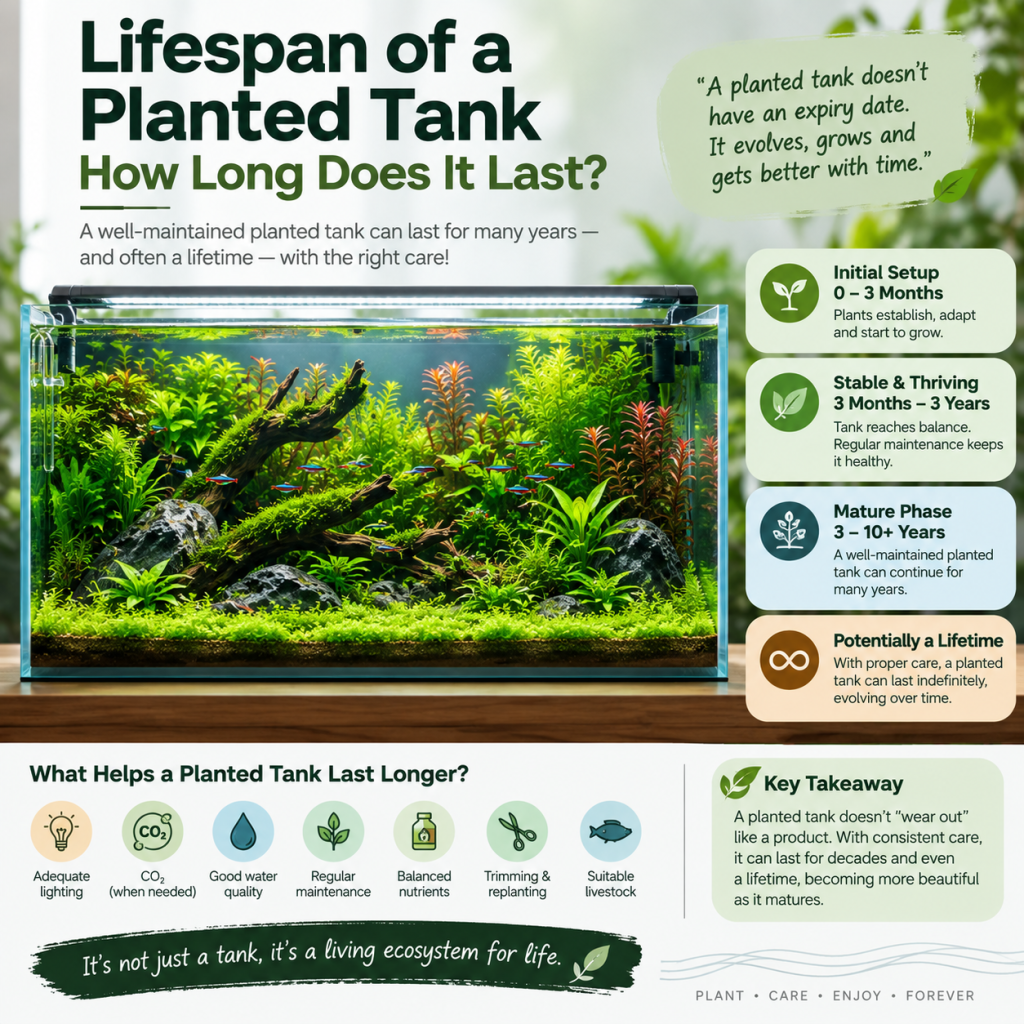
An aquarium gets its true beauty when there are plants along with fish, mimicking a natural water environment. Once you have convinced yourself to add plants to the tank and listed all the compatible ones, the next step is to know how long the planted tank will last. While most of the aquarists claim that their aquascape didn’t last more than 4 months, others say that it is immortal.
So, what’s the secret behind this? Why do some aquascapes lose their beauty early, while others survive forever? Well, it is when understanding the lifespan of a planted tank becomes important, and this article will help you get out of common aquascape average lifespan queries.
What does the lifespan of a planted tank mean?
The lifespan of an aquarium refers to the length of time your tank remains stable and functions normally before it needs major changes. When the organic waste of the tank starts accumulating and reaches every part of it, that’s the point when the tank starts deteriorating and dying. With more waste, water parameters start changing abruptly, among which pH suffers the most. As a consequence, the health of livestock and plants is impacted negatively.
Usually, this kind of situation arises between the second and third year of aquascaping. For a non-buffered tank, replacing substrate after a year or a year and a half is considered ideal for maintaining its health and vitality.
(*non-buffered tank: A tank where the water has little or no buffering capacity, so the pH changes easily and quickly.)
While changing other accessories like hardscape, filter, pumps, or even bio-media is not necessary, replacing the substrate is. It is the only thing that needs to change to ensure that the lifespan of the planted tank can be increased.
Therefore, understanding the plant alone is not of any use until you know about the life of your substrate and how frequently it needs to be changed.
How long does a planted tank last?
When you have some experience in aquascaping and have added healthy plants, it is expected that a planted tank will last on average about six months.
However, this period can be expanded with some knowledge, and getting a thriving immortal tank is possible. On the contrary, if there is a lack of knowledge about the care and maintenance of a planted aquarium, you may end up with dead livestock in just one month.
Different factors determine how long the planted tank will last. From the plants and livestock to their setup and maintenance, everything counts. If you maintain the parameters of the aquarium, clean it regularly, and deal with its organic waste, you can expect it to last longer. However, these things alone won’t decide the lifespan. The setup used and how well it is maintained count equally.
Let’s learn about them in detail.
Factors affecting the lifespan of Aquascape
Various factors play a role when it comes to the number of years a planted tank lasts. Below is the list that will help you understand how different things contribute to the life of an aquarium and how you can adjust them to prolong it.
- Aquarium Glass– If you think cleaning substrate is the only thing that matters, you are wrong. Cleaning the aquarium glass is equally important, as it accumulates algae over time. Algae grows when the water flow is less.
Gradually, it spreads, coating the interior of the tank’s glass. It not only decreases the tank’s aesthetic and makes the glass unclear, but also reduces the lifespan of a planted tank. So, whenever you clean the aquarium, make sure you clean the interior of the glass as well.
- Trimming Plants– Different aquarium plants have different growing habits. If you have planted some fast growers like Amazon Sword, Vallisneria, Hornwort, Rotala, etc., make sure you trim them after regular intervals. Even though the lush greenery looks stunning, trimming the overgrowing plants is essential to maintain the look.
Apart from giving space for fish to swim, regular trimming of overgrown plants will also help in reducing the accumulation of organic waste. Try to maintain a natural habitat for the fish without letting the plants overtake their space for moving.
- Light intensity– Light controls the stability of a planted tank. Proper light ensures a long-lasting and stable ecosystem because it controls the speed of metabolism. While strong light pushes plants to grow rapidly, demanding more nutrients and carbon dioxide in the process, low or moderate light slows things down.
Therefore, including plants that stay healthy in moderate light and perform well are the best for having a long-lasting aquarium. With high light intensity and fast-growing plants, the organic waste accumulation will increase, and the tank will require frequent cleaning. At the same time, algae will respond faster.
- Organic particles– During their entire growing phase, plants shed and generate organic waste. Leaves die and fall, branches break, and sometimes even the healthy leaves break off due to fish movement. All this leads to the accumulation of waste that increases toxicity in the tank.
In such cases, removing waste from the aquarium as soon as possible helps (basically, before it starts to decompose).
- Cleaning the filter– The filter is the backbone of a healthy aquarium. It contains beneficial bacteria that keep the entire tank hale and hearty. However, over time, algae colonize the filter and make it their home. As waste material draws into the filter, algae multiply, filling the filter. It is when cleaning the filter without disturbing the bacterial colony becomes essential.
However, you need to be extremely careful while cleaning the filter. Using tap water or cleaning aggressively will cause more harm than help. Since beneficial bacteria live in bio media, filter sponge, bio balls, and ceramic rings, make sure you leave these parts and clean the rest gently.
- Cleaning decorative items– No matter how much beauty decorative items bring to a tank, they become home to algae, bacteria, and other organisms after some time. Therefore, once you have kept them inside water, make sure you do not forget to clean them as well.
Even if the decorative items are natural products like driftwood and rocks, you need to take them out during the cleaning process, rinse thoroughly, and then put them back. In this way, the water chemistry will not alter due to dirty décor items.
- Regular water changes– It is one of the non-negotiables when it comes to a clean and healthy aquarium. Changing water after regular intervals should be a part of the routine for every aquarist. It will help keep the water and make the space breathable for the plants and livestock.
When the plants are in natural water like rivers, the flowing water body keeps changing the ecosystem. Such plants are never deprived of clean water that has high oxygen content. However, when the plants are in a stagnant condition, like in an aquarium, the oxygen level depletes over time. It is because both fish and plants consume it.
Therefore, changing at least 25 to 30% water once a week or 50% once every 15 days will ensure that your aquascape is in good condition. You must learn how to change an aquarium’s water properly without compromising the life of the fish. Changing water too frequently is not recommended at all, as it will put fish under stress.
The plus point of having plants in the tank is that they perform photosynthesis and keep up with the reduced oxygen levels. However, besides oxygen, there are n’ number of things that are needed for a stable and long-lasting tank.
- Regularly checking livestock– Besides plants, you also need to keep an eye on the livestock in the tank. There are different fish with different requirements, and some of them may not be the best fit with certain plants. For instance, goldfish may get stressed when the tank has carpeting plants like Monte Carlo. Likewise, lots of driftwood or tanning-producing botanicals do not go well with African cichlids.
If it seems that the fish is stressed or behaving abnormally, it could be because of a certain plant. In such cases, remove the fish from the tank as soon as possible and place them in another tank until it recovers. In the meantime, study the fish and the plants, and if there is a plant unsuitable for the fish, remove it as well.
- Temperature– Temperature is another important aspect, after pH and light intensity, that requires a critical review. It is important for both fish and plants. If the temperature rises beyond the limit, the oxygen in the water will decrease. To overrule fluctuations in temperature, you may install a device that will manage and keep track of it.
In the same way, if the temperature gets too cold, most of the freshwater fish will not be able to cope up. If you have installed a heater to maintain it, ensure that it works efficiently. Using LED light is another safe option to control the tank’s temperature.
- Carbon dioxide– While most of the aquarium plants do not require carbon dioxide, there are others that grow well only under additional CO2. Even if you are added CO2 or not, ensure that its level is within the range. High carbon dioxide levels will make the fish unwell.
- Lack of nutrients– Nutrients are essential for the healthy growth of inhabitants and a better lifespan of the planted aquarium. When the plants do not receive enough nutrients, their growth may seize and leaves may start dying, causing increased organic waste.
Therefore, know if your plants need root tabs or liquid fertilizers and provide them in an adequate amount. The more your plants attain a stable life, the more your tank will get stable. Replacing water in regular intervals also reduces the amount of toxic chemicals that develop overtime due to plant and fish waste and replenishes the nutrients.
Increasing the lifespan of the planted tank
A stunning aquascape is created by adding all types of plants- foreground, midground, background, carpet, as well as floating plants. And when they get ideal water condition, they multiply rapidly, especially the fast-growing aquarium plants, and cover the whole surface. In such cases, you need to keep their proliferation in check.
Another thing that you need to keep in mind is not adding too many plants to a tank. More the number of plants there are, the more organic waste and it will only contribute to making the aquarium unstable. This, in turn, will reduce the lifespan of a planted tank. Likewise, overstocking the tank will also result in excessive waste accumulation.
Other than these, maintaining stable water parameters is the key to prolonging the lifespan of the planted aquarium. Make sure pH, temperature, and water hardness are within the range. In the same way, plants are getting enough nutrients to stay healthy.
Final words
The short answer for how long a planted aquarium last is between 6 months to 2 years, depending upon how well you maintain it. If you are able to maintain stable water parameters, you can easily prolong the lifespan; however, if they keep fluctuating and plants and fish come under stress, there are high chances of a short lifespan.
Besides, cleaning the substrate and removing all the organic waste materials before they start decomposing also helps in prolonging the lifespan of a planted tank. So, maintain a cleaning schedule where you will replace water, clean the glass of the aquarium, filters, décor items, and other accessories installed.
Lastly, ensuring that all the factors affecting the lifespan of an aquascape are within control will help in adding life to a planted tank. Knowledge and experience make it possible.
Please fill in the form get updates on new articles.
