
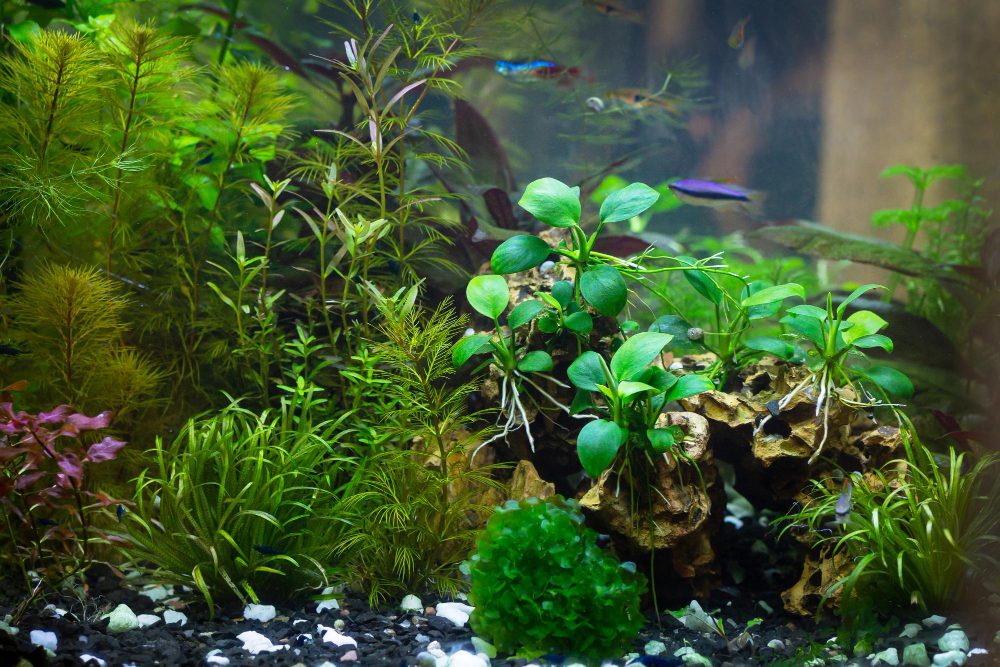
As an aquarist, adding live plants to the tank could be one of your best decisions. There is no exaggeration in saying that plants offer innumerable benefits to the water quality and fish health. However, everything comes with its own risks, and when plants are not properly taken care of, they may do more harm than help to aquarium life.
Apart from taking care of your plants and keeping an eye on their growth, you must also know that any random plant cannot be added to an aquarium. Neglecting these points can harm your fish and sometimes even kill them.
This article is not to discourage aquarists in keeping live plants, but rather how they can make the best out of them and grab as many benefits as possible. It will also discuss the potential ways plants can pose harm to the fish and how to prevent them. This will help aquarists keep their plants healthy, fish safe and tank’s water best for the aquatic life.
Before delving further, let’s understand how live plants can help maintain a healthy water ecosystem in your tank. Below are some common benefits
- Act as a natural filter
- Create a lush-green aquascape
- Improve fish health
- Make the aquarium more appealing
- Provide shelter and security
- Act as a natural food source
- Reduce stress in fish
- Provide a natural look to the tank
- Control algae
So, having live plants means increasing the quality of water and enhancing the aesthetic of the aquarium. Now, coming to some of the risks that may come with your live plants and ways to prevent them.
DISEASES
While the chances are low, live plants can cause certain health issues in fish. Among them, parasitic diseases are most common, such as ich.
Ich is a white spot disease that occurs when fish come in contact with the responsible parasite. These parasites often hitchhike when you introduce a new plant in your tank without proper sanitization or disinfection. Store-bought or online-bought plants are often disinfected and grown in healthy conditions. However, when you add a plant from any contaminated source, there is a high chance of getting parasites along with it.
Therefore, properly treating the plant or quarantining it in another tank is advised. In fact, you should disinfect everything that you plan to introduce in your tank– be it a plant or any décor item because anything could be infected with harmful parasites and pose a risk to the fish’s health.
Signs of Ich in fish
If you see white spots or clumps on the fish’s body, it could be a telltale sign of parasite infection. Besides, fish will look lethargic, less active, and have less food consumption. Since it is a parasitic disease, control is essential before it becomes deadly and spreads further.
Controlling Ich
Quarantining the fish and plants is the first step to control the spread of ich. Once the fish are moved to another tank, add the medication into the tank with plants. Salt is considered an effective form of medication. Treating with salt for a few weeks or increasing the temperature of the tank till the point that plants can handle will also be beneficial.
Parasites die when there is no host. Once you have taken all the measures, change the entire water and clean all the decorations or gravel. Now, put your fish back in the tank and allow them to settle in the new environment all over again.
INCREASED AMMONIA
Decay of plant tissues due to microorganisms such as fungi or bacteria is called plant rot. Besides, when the plant didn’t get enough nutrients, light, or other factors that are essential for its healthy growth, it begin to melt or rot.
Rotting is not healthy for the tank’s water. Dead and decomposing plants build up ammonia in the tank, and if the concentration goes above and beyond, it becomes toxic to fish. In addition, ammonia converts into nitrite, and this gas, in high concentration, is equally harmful. It hampers water quality.
On the contrary, when the plants are healthy, they help absorb and neutralize ammonia that may develop due to leftover food particles and fish excreta. In this way, healthy plants keep the water quality balanced. So, if you are not managing the plants or making the efforts to maintain their health, they may pose a risk.
As you add living organisms to your tank, such as fish and shrimp, you should make an effort to keep the ammonia level low and consistent. For this, keeping the plants healthy by providing proper light, nutrients, and taking care of them is essential.
In addition, you need to prune the plants regularly and remove the pruned stems or leaves immediately from the tank to avoid them from rotting and creating all the ruckus.
CHEMICAL LEACHING
What plants you select for your tank is a serious matter of concern. You may find an extremely pretty plant in the store that is not a true aquatic species. If you introduce it into the tank without proper investigation, there is a high chance that it will hamper the water quality.
Such plants can begin to rot when kept emersed and leach toxins into the water. Also, if these plants were treated with chemicals (fertilizers or pesticides) previously, they may release them in the tank and poison fish.
The best way to avoid this situation is knowing which is a true aquatic plant and which will rot when grown emersed. Always buy from a trusted source and never fall for the trap of mislabelled plants for aquatic use. Also, never add any plant randomly that you see growing inside the river, lake, or pond. Not every water plant is suitable for an aquarium to live with fish.
WRONG PLANT SELECTION
We have already mentioned in the ‘chemical leaching’ section how a wrong plant can damage the water ecosystem and become toxic to fish. In addition to this, if you are growing an aquatic plant incorrectly, for instance, growing a submerge plant in an emersed condition or vice versa, it may be dangerous as well.
Submerged plants grow completely inside the water, wherein all the plant parts– stem, leaves, and roots grow inside. Emersed plants are those wherein only the roots and some part of the stem stay inside, while the rest of the plant parts, like leaves and the rest of the stem, grow above the water surface. If you grow one plant in the other way, it will begin to rot and increase the concentration of ammonia and nitrite.
In addition, there are certain fish that eat and munch on plants’ leaves. If you grow a certain plant that should stay a submerged condition, fish may start feeding on the leaves. If the leaves are not suitable for the fish, you are risking its health.
The best way to avoid this situation is to add only those plants in the aquarium that are compatible with your fish– whether they are submerged or emersed.
OVERGROWTH/OVERPLANTING
Overgrowth of plants and overplanting– both can cause damage to your water ecosystem. Some aquarium plants are fast growers and develop profusely, overtaking the tank within a few months. They may grow abundantly and block light and water flow. It creates dead spots in the tank with very little light, low oxygen, and high waste concentration. All this will pose harm to fish, stressing them, which may cause serious problems.
Likewise, if you add a lot of plants in the tank without giving a thought to the fish-to-plant ratio, a similar situation may arise.
The best way to avoid this is to trim the plants regularly and keep an eye on their growth. You should always avoid overcrowding the tank with a lot of fish or plants as it will eventually lead to increased bio-load. Besides, you can also take steps to ensure that water filters and pumps are in their right condition and working adequately.
OXYGEN DEPLETION
As the process of photosynthesis continues inside the tank, plants consume oxygen at night and produce oxygen throughout the day. However, if the tank is heavily planted, aeration will be poor, which will lead to low oxygen levels at night. It will cause stress among fish, and they may suffocate.
Some fish species, such as bettas, tetras, and some chichlids, are more prone to the danger of oxygen depletion. Therefore, maintaining a proper balance between fish and aquarium plants is essential.
Another tip to avoid this kind of situation is to use an air stone. Air stone is a small porous stone that releases tiny bubbles into the aquarium when connected to an air pump via tubing. As a result, it improves aeration and water circulation, which is needed to maintain a healthy water ecosystem.
Ensuring proper surface agitation to maintain oxygen levels is one of the best ways to maintain a healthy water ecosystem.
Final words
Aquarium plants are always a wonderful addition to an aquarium. They continually offer benefits to the aquatic life and water quality. However, sometimes, certain conditions may arise that make them harmful for the tank’s water and negatively impact the life of the fish.
In this article, we have mentioned all the potential problems that may arise when you add any random plant to the tank or do not take enough care of aquatic plants. We have also provided preventive tips and guidelines to overcome the problematic situations. Following them will help aquarists maintain a healthy, lively, and well-maintained planted tank with healthy aquatic life.
All you need is to monitor the plants’ health regularly and maintain proper water circulation and oxygenation in the tank. You should also quarantine and disinfect or clean the new plants before introducing them into an already established tank. Never go for untreated plants or those unsuitable for aquatic life.
A little carefulness and attention to details can make the difference!
Please fill in the form get updates on new articles.
