
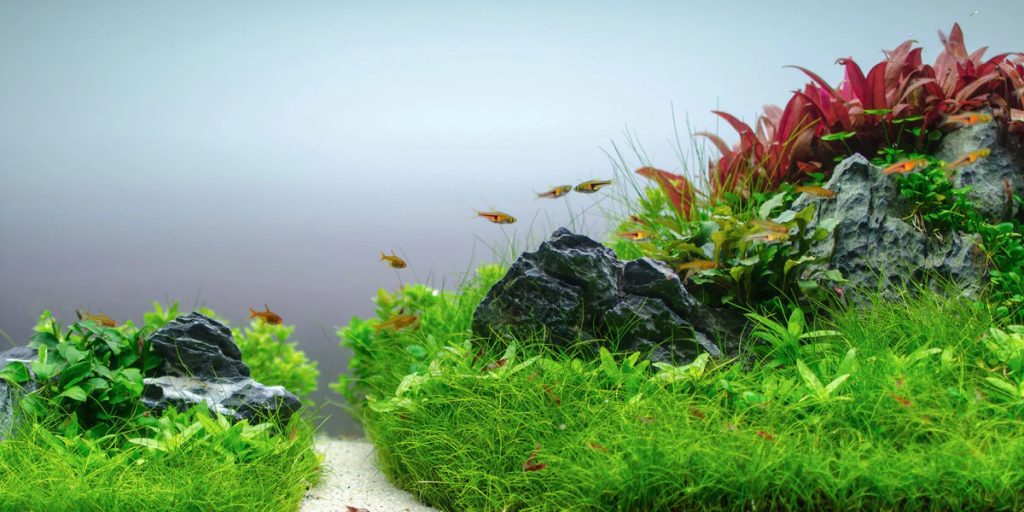
Creating an eye-catching aquascape requires selecting the right plants and décor items. Aquarium plants are of different types and heights. Irrespective of the theme, you need to have plants of varying heights to give depth to the décor. While the background plants are usually taller and are planted at the back, the foreground plants are low-growing, small aquatic plants that are placed at the front of the tank.
There are also mid-ground plants that are planted in the middle of these two. Besides, there are also some plants that can be planted anywhere, irrespective of their height, to make them the focal point of the tank.
This article will discuss some of the best foreground plants or the plants that stay small that you can grow in your tank at the front and bring more charm to the aquascape. Most of the plants in this list are beginner’s friendly and novices have them in their tank.
8 best foreground aquarium plants
- Anubias Nana Petite
Anubias nana is one of the most popular and beginner friendly aquarium plants that stay small. You can find different species of this plant coming in different sizes, and Anubias nana petite is one of them.
It is an ideal foreground plant because it is hardy and never grows beyond 5 inches. The leaves are dark green and sturdy as well. For growing Anubias, you don’t need substrate. It is recommended not to bury the roots but attach the plant to a piece of driftwood or rock.
This plant grows slowly and is strong enough to withstand minor fluctuations in water parameters. Also, it is a low-demanding plant, not requiring additional carbon dioxide and nutrients for showing the best growth.
Anubias nana petite is so hardy that aquarists claim it is impossible to kill. If you are offering it the right water and suitable conditions, it will flourish and bring lush-green look to the tank.
- Temperature- 22–28°C
- pH- 6 to 7.5
- Lighting conditions- Low to moderate light
- Growth- Slow growing
- Plating tips- Do not bury the rhizome
- Hardiness- Extremely hardy
- Maintenance- Easy to maintain, requires minimal trimming
- Bucephalandra
There are multiple varieties of Bucephalandra, and for growing it in the foreground, you have to find the one that stays small. The popular varieties of Bucephalandra are usually small, so there won’t be much hassle.
This is also a hardy plant, which makes it beginner-friendly as well. When it comes to maintenance and features, it is similar to Anubias. Both of them are flowering plants and don’t require substrate for growing. Attaching it to the wood will do the needful.
Likewise, it is a low-maintenance plant with very little to zero demands. It neither needs a very high-tech aquarium nor a large amount of nutrition. Just give it a bare minimum, and Bucephalandra will grow happily. There is no need for additional carbon dioxide as well.
For growing, all you need is to attach it to the surface of rocks, driftwood, or décor items using glue or threads. After a few days, you will see the plant growing and proliferating.
- Temperature- 22–28°C
- pH- 6 to 7.5
- Lighting conditions- Low to moderate light
- Growth- Very slow growing
- Plating tips- Do not bury the rhizome
- Hardiness- Hardy and adaptable
- Maintenance- Easy to maintain, requires minimal trimming
- Java Moss
If you want to create an aesthetically appealing aquascape, look no further than Java Moss. You can find different types of mosses, and Java moss is the most popular one in aquascaping. You can also add different variety of mosses to add more texture and features in the tank.
Mosses come in different shades of green, so adding them will give a colorful look too. In addition, you can creatively add them into different areas of your tank, like fixing them on the rocks or driftwood, glueing them around the décor, and more. Often, mosses are used for giving a carpet look.
You can find more inspiration online on how to use moss in a tank for aquascaping and use it accordingly. The best part is moss grows really low, creating carpet-look look and do not take up any space, unlike plants.
- Temperature- 20–28°C
- pH- 6 to 8
- Lighting conditions- Moderate but can tolerate fluctuations
- Growth- Fast growing
- Plating tips- Attach to driftwood, rock, mesh, etc
- Hardiness- Hardy
- Maintenance- Needs moderate maintenance because of fast growth
- Cryptocoryne Parva
Cryptocoryne or Crypt, is another aquatic plant genus like Bucephalandra whose species come in varying sizes. You can find Cryptocoryne species that are suitable for background, mid-ground, and even foreground planting. Out of them, Cryptocoryne parva is the most suitable for growing or placing at the front area of the tank.
Cryptocoryne parva does not grow more than 6 cm, making it one of the smallest species of Crypts. In contrast to other species, this variety requires bright light conditions in order to stay small. If you are offering little or dim light to Cryptocoryne parva, it will start growing upwards in search of more light. Since we are looking for small plants that are suitable for foreground placement, we need to ensure they get sufficient light in terms of both duration and intensity.
Besides, keeping stable water parameters will ensure that Cryptocoryne parva grows perfectly and stays small.
Here, it is important to mention that beginners need to be patient when growing crypt because it has the tendency to melt. Often, when you plant a crypt inside the tank, it shows the signs of melting and sheds its leaves before it adjusts to the new environment. So, do not remove or throw the plant thinking it is dead. Give it some time and see how it adjusts and adapts in the water, and restart the growth.
- Temperature- 22–28°C
- pH- 6 to 7.5
- Lighting conditions- Moderate to high light
- Growth- Very slow growing
- Plating tips- Plant rooted rosettes individually with a little spacing
- Hardiness- Adaptable and gets hardy once established
- Maintenance- Easy to maintain, requires occasional trimming
- Blyxa Japonica
There are several varieties of Blyxa that you can grow as a foreground plant, and Blyxa Japonica is one of them. The beauty of the plant has made it popular among aquarists. Also, it is easy to maintain due to low low-demanding nature.
There are only a few things that you need to keep in mind while growing Blyxa Japonica– firstly, it needs high light and secondly, added carbon dioxide. When both these requirements are fulfilled, there is nothing that can stop Blyxa from spreading. There is one benefit of growing it as well– it produces a lot of oxygen. This helps fish thrive better.
Another advantage of Blyxa is that you can create a colorful aquascape. Adding iron in the tank will offer huge benefits as it will help turning the tips of the leaves red and purple. When some foregrounds are green and the others have a tinge of red and purple, it creates a stunning contrast and brings beauty to the tank. Make sure you are not increasing the dose of iron to a very high concentration because it will hamper the health of fish and shrimps in the tank.
- Temperature- 22–28°C
- pH- 6 to 7
- Lighting conditions- Moderate to high light
- Growth- Moderate to fast
- Plating tips- Planting in a nutrient rich substrate will develop an extensive root system
- Hardiness- Moderately hardy
- Maintenance- Requires regular trimming
- Echinodorus Latifolius
If you believe that every species of Echinodorus is tall like Amazon Sword (Echinodorus grisebachii or Echinodorus amazonicus), you are wrong. There is a variety of Echinodorus that stays small, which is Echinodorus latifolius and is suitable for growing as a foreground plant.
This plant does not grow more than 10 cm in height. One thing that you need to assure to maintain this low height is offering a good amount of light. The more the light, the smaller the height. It also helps to keep the leaves narrower.
Since it grows not more than 10 cm when showered with light and leaves also stay narrow, using it as a carpet plant is a great idea. You can use it to cover the front of the tank and make a carpet look from Echinodorus latifolius. Under suitable water conditions, it will start growing offshoots or runners and spreading across the tank.
Besides light, you also need to offer additional fertilizers to this plant. A balanced combination of liquid fertilizers and substrate fertilizers will ensure that the plant is getting the required nutrients and it will sustain the growth. Adding iron and other micronutrients will help equally.
- Temperature- 22–28°C
- pH- 6.5 to 7.5
- Lighting conditions- Moderate to high light
- Growth- Moderate growth rate
- Plating tips- Plant is a well-fertilized and nutrient-rich substrate
- Hardiness- Hardy and adaptable
- Maintenance- Required moderate maintenance
- Sagittaria Subulata
This is another great aquarium plant that can be used for carpeting the tank. Also popular as Dwarf Sagittaria, it forms a dense carpet with its leaves that grows around 7 cm across the floor of the tank. The fast-growing nature of the plant makes it suitable for creating a quick aquascape.
There may come a situation when you see leaves of Dwarf Sagittaria growing as big as 50 cm. It happens when the leaves suddenly move towards the source of the light in an urgent or desperate way. The plant grows too densely, and the leaves grow uncontrollably. Due to this condition, people often sell it as a background plant. However, it happens rarely and only when there are unstable light and water conditions.
You may find this plant with other popular names as well, like narrow-leaved arrowhead and awl-leaf arrowhead. When provided with the right water parameters, there’s nothing that can stop this plant to give a carpet-look.
- Temperature- 22–28°C
- pH- 6.5 to 7.5
- Lighting conditions- Moderate to high light. Low light will make it grow tall.
- Growth- Fast growing
- Plating tips- Plant individual runners; spreads through runners.
- Hardiness- Very hardy and adaptable
- Maintenance- Low to moderate maintenance
- Dwarf Hairgrass (Eleocharis Parvula)
Another dwarf plant in the list is Dwarf Hairgrass, scientifically known as Eleocharis Parvula. This is also a foreground plant that can be used to give a carpet look. It will turn the aquarium greener and more attractive.
Offering good light is one of the best ways to keep this plant small and promote its horizontal growth. Getting sufficient light helps it stay small. You may also need to trim it once a week for the best results.
From the lush green color of the Dwarf Hairgrass to the horizontal growth pattern– everything makes it suitable for growing at the front and create a beautiful aquascape. You may add carbon dioxide to give a boost to its growth.
- Temperature- 22–28°C
- pH- 6.5 to 7.5
- Lighting conditions- Moderate to high light
- Growth- Moderate growth rate
- Plating tips- Plant in small clumps, spaced evenly
- Hardiness- Moderately hardy
- Maintenance- Moderate maintenance
So, these are some of the popular, easy to maintain, and best aquarium plants that stay small and give depth and texture to the aquascape.
Tips to keep the aquarium plants small
Keeping the aquarium plants small or controlling their growth is possible when you know and follow the tips below-
- Trim/Prune– Trimming the plants on a regular interval will ensure that they stay small. Trimming also helps in keeping the growth compact and preventing leggy growth. Cutting the stem above a node promotes bushier growth as well.
- Controlled lighting– Plants respond to light differently. While some aquatic plants will grow abundantly with high light, others will stay in their short height. For instance, when plants like Dwarf Sagittaria and Echinodorus Latifolius are offered low light, they start growing and moving towards the source of light and thus become tall and leggy. So, maintain the right light conditions to check the growth.
- Limit fertilizers– When you are not overdosing the plant with additional fertilizers or carbon dioxide, there are high chances that it will stay small.
- Use slow-growing aquarium plants– The best way to keep the plant small is using their small variants. When you are choosing such a plant, you don’t have to worry about it growing taller.
Final words
There is no denying that having plants of different heights can help in creating an eye-catching aquascape. This article has given you eight different options of foreground plants that you can grow or place at the forefront and add more depth to the tank. The tips to keep aquarium plants small will also help in maintaining the look.
Please fill in the form get updates on new articles.
